
Why Accessibility Still Matters Even Without Lawsuits
Let’s start with the thought no one in government or business says out loud, but many people think:
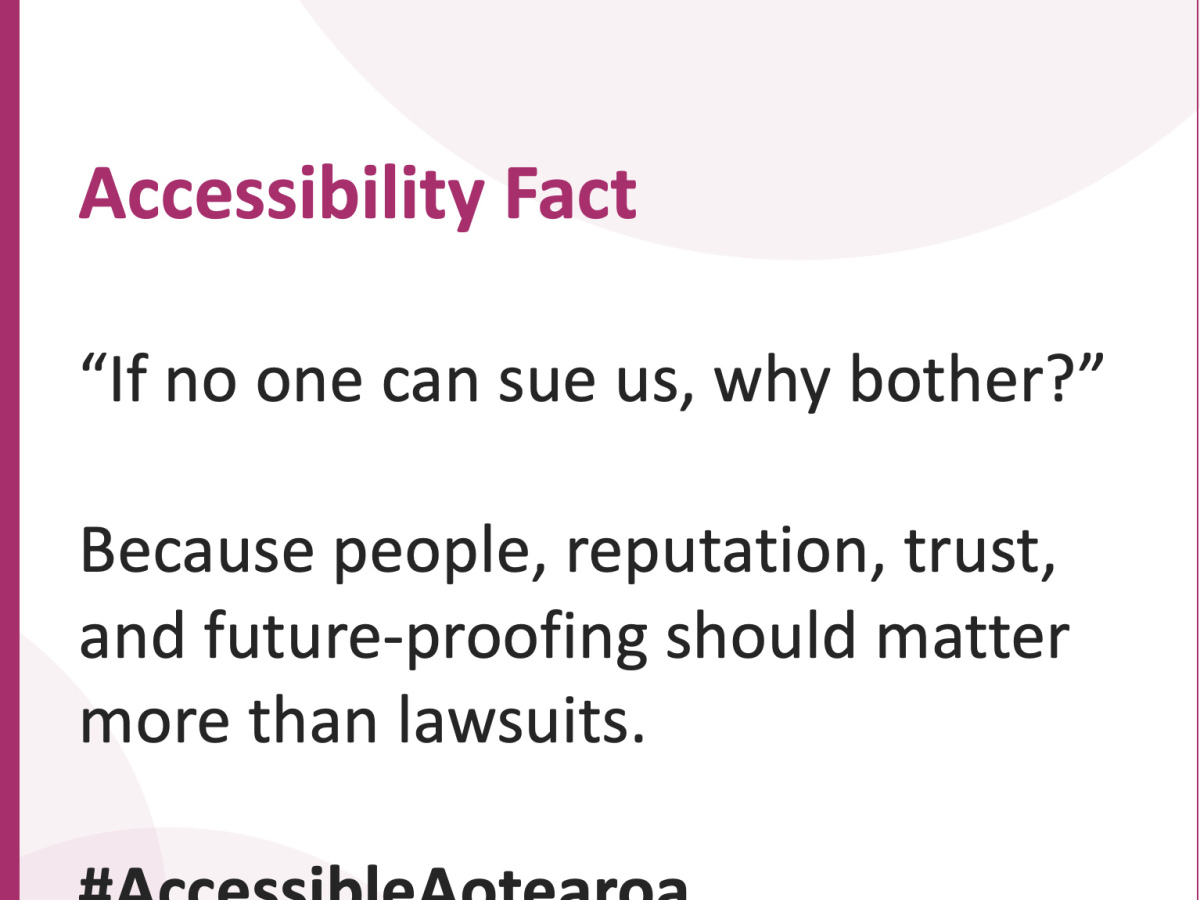
“If no one can actually sue us for this, why are we putting so much effort into accessibility?”
It’s an understandable question. Budgets are tight. Timelines are tight. Accessibility can feel complex and technical, and - if we’re being honest - easy to push down the list when there’s no obvious legal hammer.
But here’s the uncomfortable truth: Accessibility still matters deeply in Aotearoa New Zealand government, even without a courtroom drama waiting to happen. Just not for the reasons people expect.
1. Accessibility failures don’t explode… they surface later
In practice, accessibility issues in Aotearoa New Zealand rarely lead to legal action. Instead, they sit quietly in the background.
Until they don’t.
They resurface as:
- A complaint to the Human Rights Commission
- A question from the Ombudsman
- An Official Information Act request
- A media story about excluded users
- A Minister asking, “Why wasn’t this picked up earlier?”
Accessibility problems age badly. The longer they’re ignored, the harder they are to explain.
And the world is moving. In the European Union, the European Accessibility Act became enforceable and real retailers were put on formal legal notice within days, highlighting that digital inaccessibility can be treated as direct discrimination under European law. This is a wake‑up call: when accessibility is seen as a rights issue, it eventually carries consequences for organisations that fall short.
2. “No lawsuit” doesn’t mean “no accountability”
In New Zealand, the New Zealand Government Web Accessibility Standard is mandated for public service and non‑public service departments in the Executive branch. Agencies must meet the standard and are expected to assess and report on their conformance. This includes submitting a risk assessment and management plan for any areas that do not conform. There are no on‑the‑spot fines, but there is formal accountability and record‑keeping.
This puts government agencies on record as knowing people are being excluded, and accepting that risk. That’s not a legal problem. That’s a governance problem. And governance problems tend to show up at exactly the wrong time: during restructures, budget reviews, Ministerial changes, audits, or moments of public scrutiny.
Accountability is also becoming more visible. The Government Chief Digital Officer’s Centralised Web Accessibility Checker programme scans public‑facing government websites every quarter and publishes indicators of accessibility performance. Again, not fines—but clear signals of maturity and risk.
3. Someone always pays (just not who you expect)
When accessibility is ignored early, it doesn’t disappear. It comes back as:
- Expensive retrofits
- Urgent remediation work
- Consultants brought in under pressure
- Delays to launches and services
- Embarrassing “how did this get missed?” conversations
So the choice isn’t: “Spend money on accessibility or not.”
It’s: “Spend it deliberately now, or urgently later—with scrutiny attached.”
International experience also shows another angle. When organisations invest early, they don’t just avoid risk, they win customers. During peak shopping periods, brands that improve accessibility and tell people about it see commercial upside. Enforcement and reputational pressure are real, but so is the opportunity.
4. Accessibility failures don’t look neutral—they look careless
No government agency or business purposely intends to exclude disabled people. But intent doesn’t matter much when the outcome is exclusion.
When a disabled student can’t access learning material, or a parent can’t use an online service, the story isn’t:
“Accessibility is complicated.”
The story is: “Why didn’t the Ministry think of this?”
And once that question is asked publicly, technical explanations don’t land well.
European enforcement reinforces the point: where essential services—like online shopping—cannot be used independently by blind customers or keyboard‑only users, it is increasingly framed as rights‑based exclusion, not mere “technical debt.”
5. Reputation impact is the real risk—and it’s fragile
Government agencies operate on trust:
- Trust from the public
- Trust from Ministers
- Trust from other agencies
Accessibility failures quietly erode that trust.
Not because of malice, but because they signal:
- Short‑term thinking
- Poor digital governance
- A gap between values and delivery
That’s far harder to repair than a single checkpoint in the Web Content Accessibility Guidelines. The direction of travel in Aotearoa New Zealand is clear: stronger, clearer standards; broader scope beyond websites; and system‑level work to make services accessible by default. Agencies that ignore this trend will be visibly out of step.
6. Future‑proofing decisions is what accessibility is really about
Most accessibility issues aren’t caused by bad people or bad intentions.
They’re caused by:
- Accessibility being bolted on later
- Decisions made without considering access needs
- Not including people with lived experience in the testing process
- Teams assuming “we’ll fix it later”
Accessibility matters because it forces better decisions earlier, when they’re cheaper, simpler, and less visible.
It also pays to communicate improvements. Many organisations fail to measure return on investment or to tell customers what they’ve improved; that’s a missed opportunity to build trust and momentum.
The quiet truth
In Aotearoa New Zealand, accessibility isn’t about avoiding lawsuits. It’s about avoiding being the government agency that has to explain—to a Minister, an auditor, the media, or the public—why disabled people were excluded from essential services. That explanation gets harder every year, as standards strengthen and monitoring becomes more visible.
But the work to avoid it doesn’t have to be hard. If you’re unsure where your organisation really stands, start with a conversation, a review, or an honest look at what’s already in place. Progress doesn’t require perfection, just willingness. Accessibility is easier to build in than to explain away later.
Practical first steps
- Do a quick risk snapshot of your website and top tasks, including manual checks with people who use assistive technology.
- Map accountability: who owns accessibility in your organisation, and how will risks be recorded and managed? (Start aligning with the government’s expectations for risk assessment and reporting.)
- Build early into workflows: include accessibility in design briefs, procurement, and acceptance criteria for new features.
- Tell your story: publish a plain‑language accessibility statement. Share improvements in ways that feel human and practical, not just technical notes. Internationally, communicating improvements helps people find and use your services.
7. Get in touch with Access Advisors
If you’d like help understanding your current accessibility risks or figuring out practical next steps, we can help with:
- Accessibility Snapshot — a fast, plain‑English review of your biggest risks and easy wins.
- User research — involve disabled people early to future‑proof decisions.
- Governance and reporting — set up the routines and artefacts you’ll need for the Web Accessibility Standard and risk management.
- Upskilling — simple training and coaching to help teams bake accessibility into everyday work.
Email us to book a short call or an on‑site session. We’ll meet you where you are, keep it practical, and focus on progress not perfection.