
Our Thoughts: Draft Digital Accessibility Standard
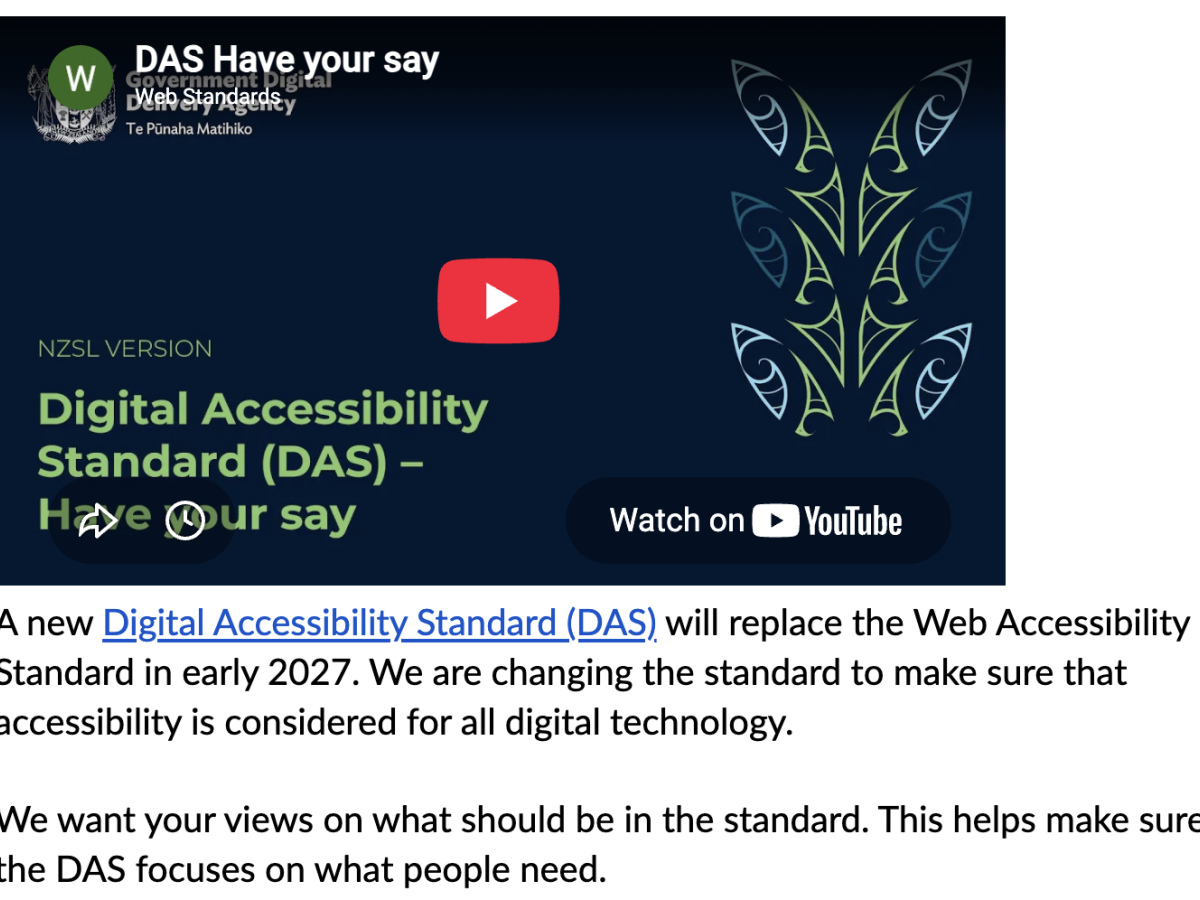
The New Zealand Government has released the draft Digital Accessibility Standard (DAS) for public consultation. Feedback is open until 7 August 2026. If adopted, the new standard is expected to replace the current Web Accessibility Standard in early 2027.
At Access Advisors, we think this is a positive step forward. More importantly, we think it is a conversation worth being part of and encourage you to provide feedback.
So, if you work in government, deliver services to government, create digital content, manage websites, publish documents, develop software, or advocate for disabled people, now is the time to read the draft and provide feedback. Standards shape priorities, funding decisions, procurement requirements, and ultimately the experiences people have when accessing information and services.
More than just websites
The most significant change is that the proposed standard moves beyond the traditional focus on websites. The draft DAS applies to a much wider range of information and communication technology (ICT), including:
- Web pages
- Non-web documents
- Mobile applications
- Non-web software
- Hardware and related technology products and services.
This reflects a reality that accessibility professionals have known for years and we always apply. People don’t experience services as separate websites, documents, apps, and software platforms. They simply experience the service. A person might start on a website, download a PDF, complete a form, receive an email, and interact with a mobile app, all as part of the same journey. Accessibility needs to work consistently across that entire experience.
Formalising non-web accessibility
Some people will see this as a major shift. In practice, it is more of an evolution than a revolution. The core technical requirement for the draft DAS is the use of EN 301 549 as its. This European standard references the Web Content Accessibility Guidelines (WCAG) and extends accessibility requirements across a much broader range of digital products and services.
Likewise, WCAG 2.2 is often still described as a "web accessibility" standard. The reality is that many of its principles apply well beyond websites. Organisations around the world are already using WCAG to guide the accessibility of digital documents, mobile applications, software interfaces, and other digital experiences. W3C even includes Guidance on Applying WCAG 2 to Non-Web Information and Communications Technologies (WCAG2ICT).
From our perspective, the draft DAS largely reflects the direction that accessibility practice has already been moving towards for several years. That's a good thing. Good standards should provide clarity and consistency, not surprise organisations with completely new expectations.
Document accessibility
One area we are particularly pleased to see included is non-web documents. The draft explicitly brings documents into scope and introduces requirements for publicly facing digital documents. For many organisations, documents remain one of the biggest accessibility challenges.
Organisations may have reasonably accessible websites but these sit alongside large collections of inaccessible PDFs, Word documents, forms, reports, policies, and consultation papers. These documents often contain critical information about people's rights, responsibilities, services, and opportunities, and many are published online.
Inaccessible documents can create barriers just as significant as inaccessible websites. In fact, because documents often communicate important information, those barriers can have serious consequences. The International Association of Accessibility Professionals also sees document accessibility as a specialist discipline through its certification for Accessible Document Specialists (ADS).
We hope the inclusion of document accessibility encourages organisations to:
- Review their publishing practices
- Invest in staff capability
- Move accessibility earlier into document creation workflows
- Consider when documents are actually necessary.
HTML-first approach
Another encouraging aspect of the draft is the recommendation for HTML-first publishing. Publicly facing information and services should primarily be delivered as accessible HTML web pages and not only as mobile applications or non-web documents. This aligns strongly with accessibility best practice and our company’s approach. However, alternate formats such as New Zealand Sign Language and EasyRead remain vital for some people and types of information.
Accessible PDFs and documents absolutely have their place. However, when information can be provided effectively as HTML, it is often easier to access, easier to maintain, easier to adapt to different devices, and easier for assistive technologies to interpret. The best document is sometimes no document at all.
Accessibility statements matter
The draft DAS also introduces requirements for accessibility statements and accessibility-related contact information on public digital services. These statements would need to identify known issues, explain how users can seek help, and describe plans for improvement. Access Advisors already encourages clients to publish an accessibility statement as part of their ongoing accessibility work.
Accessibility is rarely a destination where everything is perfect at launch. It requires ongoing improvement. Clear accessibility statements help build trust because they acknowledge known barriers, explain what support is available, and give people a way to provide feedback. Transparency is often more valuable than perfection.
Questions that need attention
As consultation continues, we encourage people to look beyond the technical requirements and consider these practical questions:
- Will organisations receive enough support to implement the standard effectively?
- How will capability be built across government?
- How will implementation and compliance be monitored?
- What guidance and resources will be available for document accessibility?
- How can accessibility be embedded into procurement and vendor management?
- How can disabled people remain actively involved in testing and decision-making?
A standard alone will not create accessible experiences. Success also depends on leadership, skilled people, effective processes, inclusive procurement, practical training, and an organisational culture that keeps disabled people involved.
Our overall view
Overall, the draft Digital Accessibility Standard is a positive step. It modernises the current approach, recognises that accessibility extends beyond websites, strengthens expectations for documents, software, and mobile applications, and encourages greater transparency through accessibility statements and contact channels.
Most importantly, it reflects a broader understanding that digital accessibility is not a website issue. It is a service issue. For organisations that have already been taking accessibility seriously, much of this will feel familiar. For others, it signals where expectations are heading and provides a useful framework for planning.
The consultation period is short, and this is an important opportunity to influence a standard that could shape New Zealand’s digital accessibility landscape for years. Read the draft, consider how it would affect the services you provide or use, and submit your feedback before 7 August 2026.
Kōrero Mai
If you would like help creating accessible documents, websites, apps, and digital content, we are here to help. Kōrero mai, reach out and send us an email.