
Deafblind Awareness Week 2026
This week is Deafblind Awareness Week 2026, with the theme Breaking Barriers, Building Bridges. It is a theme that speaks to real and everyday experiences. It reflects what happens when access is taken seriously and when connection is designed in ways that include everyone.
Deafblindness, or dual sensory loss, is often not even considered and very commonly misunderstood. Having impairments to both sight and hearing doubly affects how a person experiences the world, communicates, and connects with others. Deafblindness ranges from mild to complete impairment in sight and hearing, possibly differing from one eye/ear to the other. No two people experience deafblindess in exactly the same way and it often worsens with age.
What this means in practice is that many of the ways people usually receive information are not always available or reliable. Sound and sight are often reduced or missing, so connection and intereaction with the world happens differently. It might happen through touch, through movement, through adapted communication, or through technology. When those pathways are supported, barriers begin to fall away and new opportunities open up. 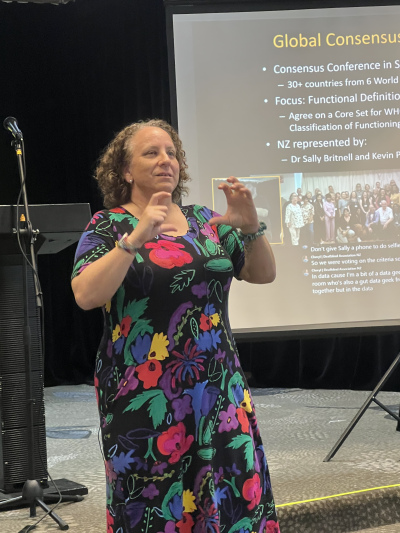
Breaking barriers
The idea of breaking barriers and building bridges is already apparent in Aotearoa. There is a growing shift in how experiences are designed. Instead of accessibility being added at the end, it is being considered from the beginning. Small changes are making a noticeable difference. Clear communication, well structured content, and information available in different formats all play a role in making something truly accessible.
For example, this can be seen in local initiatives like a an upcoming Christchurch City Tram journey which will include audio description alongside the standard commentary. For someone who cannot rely on their sight, and might struggle to hear the main commentary, this turns a simple ride into a fully described experience, bringing the surroundings to life through detail and storytelling.
A similar approach was used during Open Christchurch, where tours around Mona Vale and the new One Stadium included descriptive elements. These additions helped people engage with architecture in a meaningful way. Audio description fills the gap where visual detail usually carries meaning, adding context, depth, and richness. These are practical examples of barriers being reduced in real spaces.
Building bridges
Kevin Prince, one of our accessibility consultants, also happens to be the President of the Deafblind Association of NZ. He and many others contribute their time, knowledge, and lived experience to support people who are deafblind from across the motu (country).
Through these shared efforts, there is a clearer picture of what is working well and where barriers still exist. There is also growing interest in research that helps build a more accurate understanding of dual sensory loss in Aotearoa New Zealand. For example, one of our Access Panel members, Dr Sally Britnell from Auckland Univeristy of Technology recently published research paper called, Deafblindness in Aotearoa, New Zealand: Prevalence and Equity Challenges From a Cross-Sectional Census Analysis.
This work is particularly important as deafblindness is still not formally recognised as a distinct condition in New Zealand. Recognition plays a key role in how services are developed and delivered. Without it, gaps remain. Addressing this is part of breaking down wider systemic barriers.
Community continues to be a strong foundation
There is value in the simple act of coming together. Reconnecting, meeting new people, and sharing experiences continues to be a vital part of this space. It strengthens relationships and keeps the work grounded in real life. Across Aotearoa, deafblind community events and gatherings bring people together to share knowledge, experience, and ideas. Events like the 'Be Seen, Be Heard, Be Connected' conference create space for discussions around advocacy, services, and the role of technology. It was at last year's Deafblind Assosication of NZ's conference that the first ever Deafblind Awareness Week was announced and celebrated. World first.
Communication
These events show how communication needs to be adapted. For people who are deafblind, communication is not limited to speech or standard forms of sign language. Instead, communication can be tactile, visual, and auditory all at the same time.
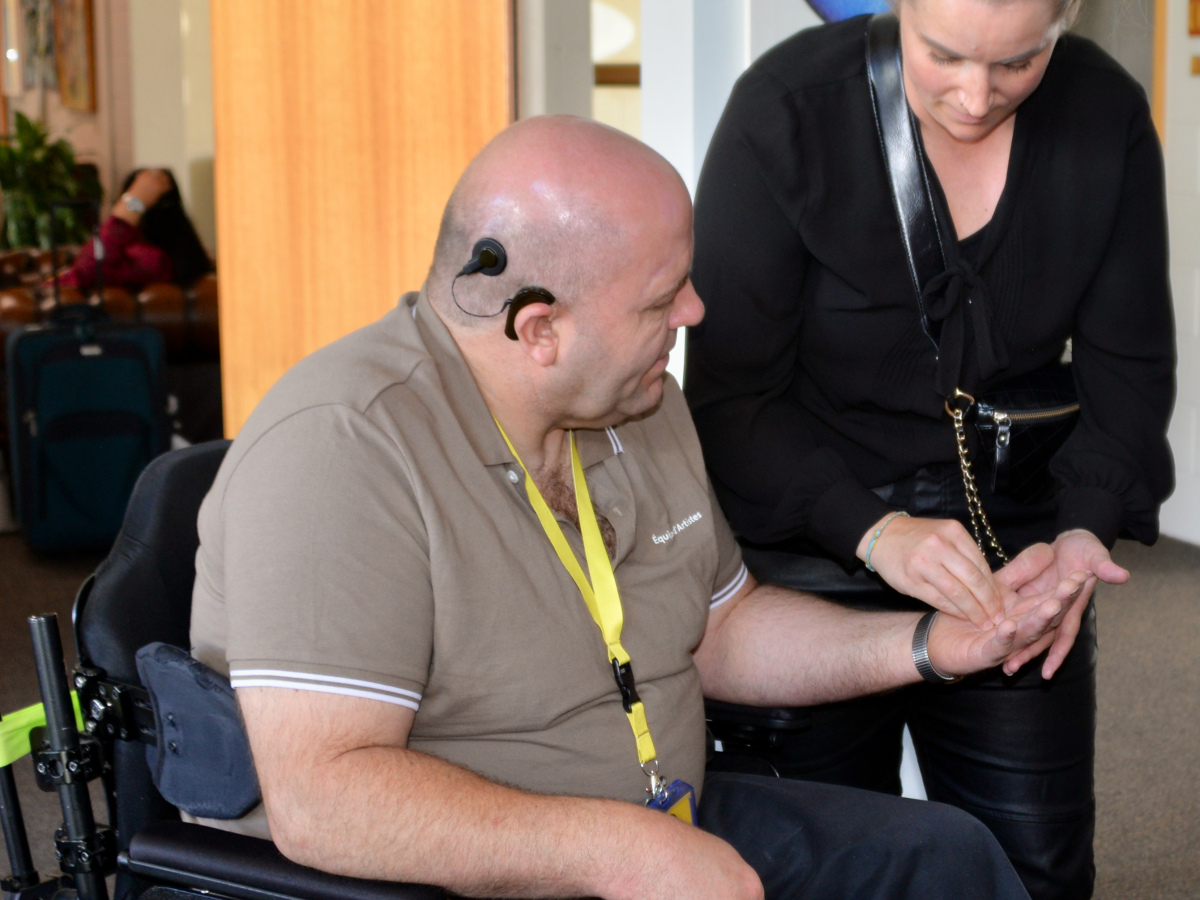
Social haptics adds another layer, allowing people to share reactions, emotions, and context through touch. It makes it possible to follow the flow of a conversation, understand group dynamics, and feel included in a way that is immediate and meaningful. 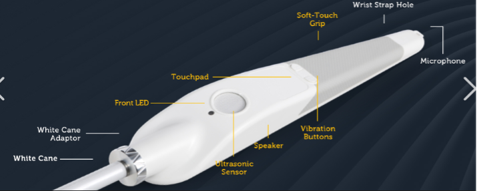
Technology is also contributing to this shift
Tools like Meta glasses are beginning to play a role in accessibility conversations, offering real time descriptions of the environment. They can provide information about surroundings in ways that support navigation and understanding. You can read other posts for more about Meta glasses and their related Privacy concerns.
As technology grows and is incorporated into assistive tools, so does the debate about how technology is used. Privacy, data use, and personal choice remain important considerations. Building bridges is not only about access to tools. It is also about trust, control, and ensuring that people feel safe using them. These conversations are already happening within the deafblind community, grounded in real experience and focused on what works in everyday life.
Another tool to support people who are deafblind are smart canes (like the WeWALK Smart Cane 2 pictured) . Smart canes combine the traditional white cane with features such as voice navigation, haptics, obstacle detection, and AI support that can be integrated into hearing aids.
What stands out about this particular device is that it has been shaped by people with lived experiences of the deafblind community. It reflects real needs rather than assumptions. Our Access Panel can be used to help learn about thoese lived experiences.
One of the key assistive technology benefits for deadfblind people is dynamic Braille displays. These use screen reader sotware but output Braille rather than speech. There are version that use a qwerty keyboard like the Mantis that Julius is using in the image and ones that use Braille input like the Braille Note. 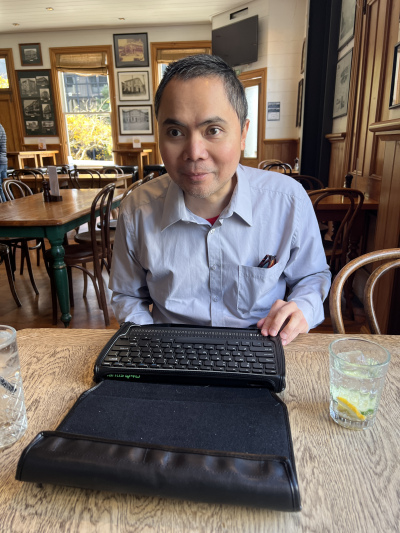
Legacy of Helen Keller
The date of Deafblind Awareness Week links back to the legacy of Helen Keller, whose work helped shift global understanding of deafblindness and communication. Helen Keller was born on 27 June 1880 and her influence continues to shape conversations about deafblindness today. She was born into a society that was not set up to support someone who was blind or deaf, let alone both.
There is still at least one deafblind New Zealander who remembers her visit in the late 1940s. One personal account describes a child watching her communicate through an interpreter using tactile methods. The words themselves were difficult to follow, but the process of communication left a lasting impression. It showed that meaning could still be shared clearly without relying on sight or sound. That story is captured on our Blog - Helen Keller’s visit to NZ – a childhood memory . Moments like this have carried through generations. They have helped shape how people think about communication, access, and possibility.
What stands out now is how communication and technology has changed to meet the needs of deafblind New Zealanders. Hopefully, this is an indication that accessibility is no longer a separate consideration. It is becoming part of how spaces are designed, how information is shared, and how participation is enabled. Breaking barriers and building bridges is not a single action. It is an ongoing process. It happens through design, through technology, through community, and through shared understanding. Deafblind Awareness Week is a chance to recognise that progress and to continue building on it.
Reach out to us if you'd like to learn more about how to design digital systems that reduce barriers for people who are deafblind. We are always happy to help.